For years, critics argued that cryptocurrency would never become part of mainstream finance.
Governments were skeptical.
Major financial institutions kept their distance.
Many political leaders openly criticized digital assets.
Fast forward to today, and the landscape looks very different.
One of the most striking examples is United States President Donald Trump, whose growing connections to the digital asset industry are becoming impossible to ignore.
Recent financial disclosures have revealed that businesses associated with Trump generated hundreds of millions of dollars from cryptocurrency-related ventures, while his overall wealth has climbed dramatically over the past two years.
But beyond the headlines and the dollar figures lies a much bigger story.
This is no longer simply about one politician making money from crypto.
It is about how digital ownership, tokenisation, and blockchain technology are steadily becoming part of the global financial system.
Hundreds of Millions From Crypto
According to a 927-page financial disclosure released by the U.S. Office of Government Ethics, Donald Trump received nearly $550 million in 2025 through his ties to the crypto startup World Liberty Financial.
The filing also details income from a wide range of businesses, including Trump-branded merchandise, licensing agreements, and more than $208,000 in royalties from Bibles sold in partnership with country musician Lee Greenwood.
Trump’s assets are currently held in a trust managed by his son, Donald Trump Jr. However, the trust’s governing rules allow it to be dissolved, meaning the former businessman could regain direct control of those assets once his second presidential term ends in 2029.
Meanwhile, Vice President JD Vance also disclosed significant income, reporting between $1 million and $5 million in royalties from his bestselling memoir, Hillbilly Elegy.
Trump’s Crypto Profits Reportedly Surpass $1 Billion — And Why It Raises Bigger Questions About the Future of Tokenisation and Ownership
Trump’s Wealth Has Grown Rapidly
The scale of Trump’s financial growth has attracted considerable attention.
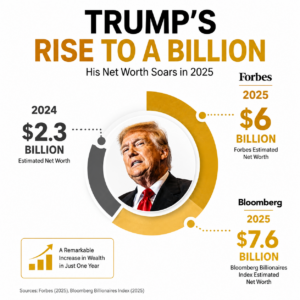
According to Forbes, his estimated net worth has risen from around $2.3 billion in 2024 to approximately $6 billion today.
Meanwhile, the Bloomberg Billionaires Index estimates his wealth even higher, at roughly $7.6 billion.
While real estate continues to represent a large portion of his fortune, cryptocurrency has become an increasingly important contributor.
Only a few years ago, many would have considered such a scenario unlikely.
Perhaps even more important than Trump’s personal financial gains is the policy direction of his administration.
Since returning to the White House, the administration has adopted one of the most crypto-friendly approaches seen in U.S. history.
Companies connected to Trump’s family have launched digital asset initiatives.
The administration appointed Paul Atkins to lead the U.S. Securities and Exchange Commission, where he has moved away from the previous enforcement-first regulatory approach and instead emphasized clearer regulatory frameworks for the digital asset industry.
Trump also signed the GENIUS Act, describing its goal as helping make the United States “the undisputed leader in digital assets.”
Whether one agrees with these policies or not, they represent a significant change in how blockchain technology is being viewed at the highest levels of government.
But This Story Is Bigger Than Crypto
Many people will focus on the numbers.
The hundreds of millions of dollars.
The billion-dollar headlines.
The growing personal wealth.
Those figures certainly attract attention.
But I believe they are not the most important part of this story.
The bigger question is this:
What happens when political leaders, governments, regulators, banks, and global corporations all begin treating blockchain infrastructure as a normal part of the financial system?
That question leads directly to tokenisation.
Trump Crypto wealth accumulation over the years
The Future May Be Built on Digital Ownership
Tokenisation is fundamentally about ownership.
It is the process of representing ownership rights to real-world assets on blockchain networks.
Those assets could include real estate, company shares, infrastructure projects, commodities, investment funds, intellectual property, carbon credits, or even government-issued financial instruments.
Rather than relying solely on traditional paper-based systems and intermediaries, ownership can be recorded digitally, transferred more efficiently, and verified transparently.
This is why so many banks, asset managers, technology companies, and governments are investing billions of dollars into tokenisation research and infrastructure.
The technology is no longer viewed only as something for cryptocurrency enthusiasts.
It is increasingly being discussed as part of the future architecture of financial markets.
Why Trump’s Crypto Success Matters
Trump’s growing involvement in digital assets illustrates how quickly perceptions have changed.
Only a few years ago, cryptocurrency was often dismissed as speculative or temporary.
Today, one of the world’s most influential political figures has businesses generating substantial revenue from the sector while simultaneously overseeing an administration that is creating a more supportive regulatory environment.
Whether these developments ultimately prove beneficial or controversial, they demonstrate that blockchain technology is becoming more deeply integrated into politics, finance, and business.
That evolution could have long-term implications for tokenisation and digital ownership.
My Final Thoughts
The headline may be that Donald Trump’s crypto-related businesses generated hundreds of millions of dollars and that his overall fortune has climbed into the multi-billion-dollar range.
But the more significant development is what this reveals about where the world may be heading.
As regulatory frameworks become clearer and institutional participation continues to expand, blockchain technology is moving beyond speculative trading.
The conversation is shifting toward financial infrastructure, digital ownership, and tokenised real-world assets.
The biggest winners of the next decade may not simply be those who buy cryptocurrencies.
They may be those who understand how ownership itself is evolving in an increasingly digital economy.
Daniel Leinhardt
Daniel Leinhardt is a Finance journalist, podcast host, and blockchain researcher known for investigating crypto scams, digital assets, and tokenisation. A contributor to international documentaries and media projects, he hosts The Crypto Investar Podcast and writes about blockchain, finance, and humanitarian innovation.