For decades, banks competed by building bigger branch networks.
The institution with the largest physical presence was often viewed as the strongest and the most accessible. Customers visited banking halls to deposit money, withdraw cash, transfer funds, pay bills, or apply for financial services.
Today, that model is undergoing one of the biggest transformations in modern financial history.
The competition is no longer centred on physical branches.
It is centred on digital infrastructure.
Across Africa, Asia, Europe and North America, banks are investing billions into digital wallets, mobile banking platforms, payment infrastructure, cloud technologies and fintech partnerships. What was once considered a convenience has rapidly become a strategic necessity.
Centenary Bank has officially launched GonzaPay, a secure digital wallet designed to make financial services faster, safer and more accessible for millions of Ugandans.
Rather than functioning as just another banking application, GonzaPay represents a significant step in the bank’s long-term digital transformation strategy.
The wallet enables users to pay utility bills, transfer money, receive payments, deposit funds, withdraw cash through agents and transact digitally from virtually anywhere.
Perhaps even more importantly, the platform is open to everyone, regardless of whether they hold a Centenary Bank account.
That decision immediately expands the platform beyond the bank’s existing customer base and positions it as part of Uganda’s wider digital payments ecosystem.
The name itself reflects the product’s objective.
“GonzaPay” is derived from the Luganda phrase “Gonza Obulamu,” meaning “make life easier.”
That philosophy is reflected throughout the platform.
Instead of asking customers to adapt to banking, the bank is adapting banking to fit the daily lives of its customers.
This is particularly important in Uganda, where many individuals still travel considerable distances simply to complete routine financial transactions.
Digital wallets significantly reduce that burden while also providing a safer alternative to carrying physical cash.
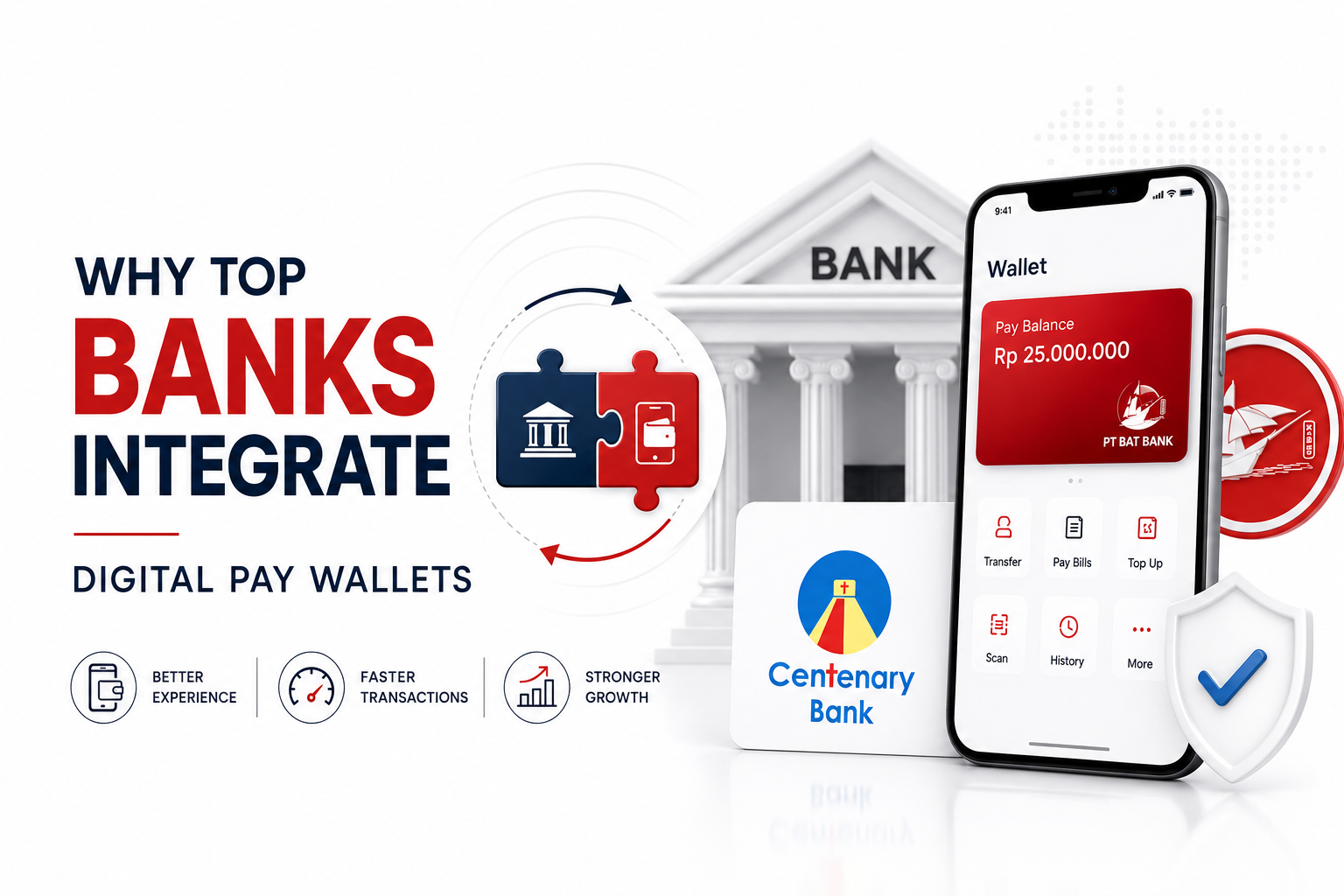
Why Top Banks Have Integrated Digital Pay Wallets A look at GONZAPAY
Uganda Is Already Moving Towards Digital Payments
The timing is no coincidence.
According to the Bank of Uganda, electronic money transactions increased significantly during 2025.
The value of transactions rose from approximately UGX 285.9 trillion to UGX 366 trillion, while transaction volumes surpassed 9 billion.
These figures reveal something much larger than increasing smartphone usage.
They demonstrate that consumer behaviour is changing.
People increasingly expect financial services to be available instantly, wherever they are and whenever they need them.
Banks that fail to provide this level of accessibility risk becoming less relevant in an increasingly digital economy.
But Uganda Is Not Alone
As I researched Centenary Bank’s strategy, I realised something fascinating.
A remarkably similar transformation has been unfolding thousands of kilometres away in Indonesia.
Earlier this year, PT BAT Instrumen Bank Internasional confirmed that it had integrated ZedPay technology into its banking infrastructure.
Initially, this might appear to be just another technology partnership.
The deeper I investigated it, however, the more significant it became.
Because what BAT Bank is doing reflects a broader shift taking place across global banking.
A building showing mapeera house main branch for centenary bank
The PT BAT Bank Case Study
For decades, banks typically built their own technology.
Payment systems.
Transfer infrastructure.
Customer portals.
Digital banking applications.
Settlement systems.
Nearly everything was developed internally.
While that approach provided complete ownership, it also required enormous investments in engineering teams, cybersecurity, software development, infrastructure maintenance and regulatory compliance.
Developing modern financial technology from scratch can take years.
Meanwhile, customer expectations continue evolving almost every month.
This creates a major challenge.
Banks are financial experts.
They are not necessarily technology companies.
Increasingly, financial institutions are recognising that building every piece of technology internally is no longer the most efficient strategy.
Instead, many are choosing to partner with specialised fintech companies that focus exclusively on developing secure, scalable payment infrastructure.
That is precisely the direction BAT Bank has taken.
Rather than spending years building an entirely proprietary digital ecosystem, the bank chose to deploy ZedPay as a core component of its digital banking infrastructure.
According to publicly available information, ZedPay supports secure transaction processing, digital banking services, balance top-ups, payment functionality and card-to-card transfers.
Instead of reinventing technology that already exists, BAT Bank has focused on integrating proven infrastructure that can scale as customer demand grows.
This allows the institution to concentrate on areas where banks provide the greatest value.
Regulatory compliance.
Risk management.
Institutional banking.
Capital allocation.
Customer relationships.
Meanwhile, technology specialists continue improving the underlying digital infrastructure.
This model dramatically reduces development timelines.
Instead of investing years building software before customers can benefit, banks are able to introduce new digital services much faster while continuously upgrading their capabilities.
Perhaps even more importantly, scalable payment infrastructure allows banks to process increasing transaction volumes without repeatedly rebuilding their entire technology stack.
The customer still sees the familiar banking brand.
But behind the scenes, an entirely different technology ecosystem is powering modern financial services.
BAT Bank has also been expanding its institutional footprint beyond Indonesia, including regulatory and compliance initiatives connected with Pakistan.
Whether serving domestic or international markets, scalable digital infrastructure becomes increasingly valuable as banks expand into new jurisdictions.
PT BAT BANK in Indonesia adopts Zedpay technology too
Two Banks. Two Countries. One Strategy.
When comparing Centenary Bank and PT BAT Bank, the technologies are different.
The markets are different.
The regulatory environments are different.
Yet the strategic direction is remarkably similar.
Centenary Bank developed GonzaPay to make banking accessible to millions of Ugandans while accelerating financial inclusion and reducing dependence on cash.
PT BAT Bank integrated ZedPay to accelerate digital transformation, strengthen payment infrastructure and avoid the enormous costs and time associated with developing every technological component internally.
Different solutions.
One common objective.
Build stronger digital ecosystems.
This comparison reveals something important.
The banking industry is quietly shifting from being branch-centred to infrastructure-centred.
Success is increasingly determined not by the number of physical buildings a bank owns, but by the strength, speed, scalability and security of its digital financial infrastructure.
Why Digital Wallets Matter More Than Most People Realise
Many people still think digital wallets exist simply to replace cash.
That view dramatically underestimates their importance.
A modern digital wallet is increasingly becoming the customer’s primary financial interface.
Once customers trust a wallet with everyday payments, banks can gradually introduce additional services through the same platform.
Savings.
Credit.
Insurance.
Investments.
Payroll.
Merchant payments.
International remittances.
Identity verification.
Government services.
The wallet evolves into an entire financial ecosystem.
Rather than repeatedly asking customers to visit branches, banks can deliver a growing range of services directly through digital platforms.
The Bigger Picture: Preparing for the Tokenisation Era
This is where the story becomes even more interesting.
As governments, financial institutions and technology companies continue exploring real-world asset tokenisation, digital wallets could become one of the primary gateways into that future financial system.
Whether the underlying assets are real estate, infrastructure, investment funds, commodities or other regulated digital assets, users will still require secure digital environments capable of storing assets, verifying identities, authorising transactions and interacting with regulated financial institutions.
In other words, today’s digital wallets may become tomorrow’s digital ownership platforms.
This is one reason I previously dedicated an entire podcast episode to explaining why PT BAT Bank’s decision to integrate ZedPay was far more significant than many people initially realised.
It was never simply about launching another payment system.
It was about recognising that the future of banking belongs to institutions capable of combining trusted financial services with flexible, scalable digital infrastructure.
Centenary Bank’s launch of GonzaPay reflects that same long-term direction.
While the technologies differ, both institutions are responding to the same reality.
Banking is becoming increasingly digital.
Ownership is becoming increasingly digital.
Payments are becoming increasingly digital.
And the infrastructure being built today may ultimately support the next generation of tokenised finance, programmable money and digital ownership.
Final Thoughts
The launch of GonzaPay is not simply another product announcement.
Nor is PT BAT Bank’s adoption of ZedPay merely another fintech partnership.
Together, they illustrate a global transformation that is reshaping the financial industry.
Banks are no longer asking whether they should digitise.
They are asking how quickly they can build the infrastructure required for the next generation of finance.
The institutions making those investments today may ultimately become the foundations upon which tomorrow’s digital economy is built.
Daniel Leinhardt
Daniel Leinhardt is a Finance journalist, podcast host, and blockchain researcher known for investigating crypto scams, digital assets, and tokenisation. A contributor to international documentaries and media projects, he hosts The Crypto Investar Podcast and writes about blockchain, finance, and humanitarian innovation.
South Korea has just made one of the biggest technology announcements in its modern history. The country plans to invest at least $880 billion into […]